The Human Workplace

  • By Kathryn Davis http://www.linkedin.com/in/kathryn-davis-io

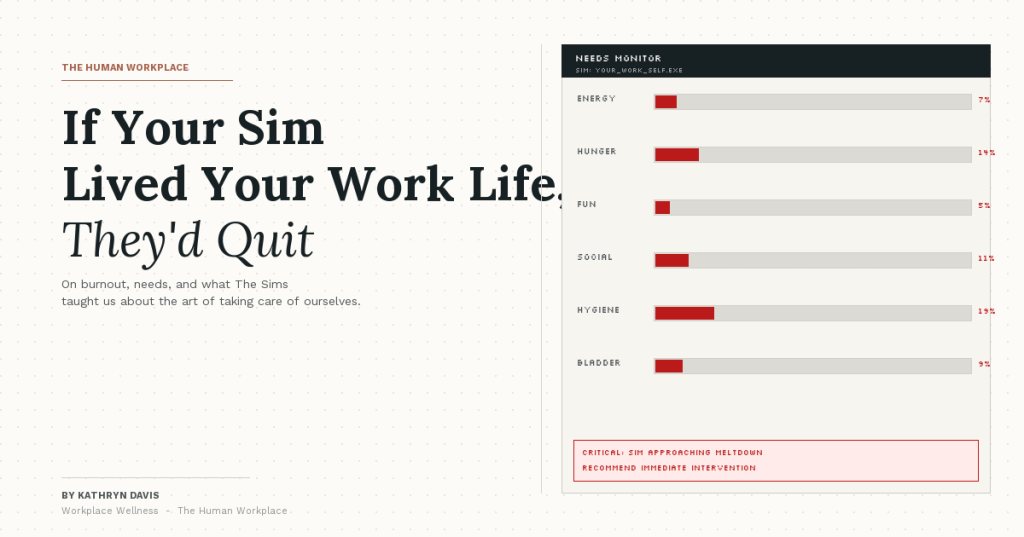
    Workplace burnout is no longer just a personal issue to be dealt with in your own time; it is a global crisis. According to Gallup’s State of the Global Workplace report (2024), burnout, or low employee engagement, costs the world $8.9 trillion every year. That is an incomprehensible number. Behind that figure, are employees suffering in silence while employers ignore the warning signs. 

    Kate Visconti, Founder and CEO of Five to Flow®, knows this cycle well. After achieving Partner status at her previous job, what should have been the peak of her career, she found herself feeling more burnt out than ever. Visconti says, “I was drowning in what looked like success from the outside while my body and spirit were screaming that something was fundamentally broken” (personal communication, August 15, 2025). This is more common than we know. What should be the pinnacle of someone’s career is often weighted down by feelings of being overwhelmed, overworked, and completely stressed out. 

    Kate’s experience became the driving force behind BurnoutIQ™, a groundbreaking assessment tool designed to reveal the uncomfortable truth about our work and wellness habits.

    The Human Story Behind the Science

    Kate Visconti’s tipping point came after a conversation with her fitness coach, Jason Haller. They noticed the warning signs of burnout in her: fluctuating weight, increased stress levels, and strained personal relationships. She knew somebody had to tackle this problem, and she chose to do it herself with her team. 

    Her personal burnout battle shaped BurnoutIQ’s™ goals. The tool values alignment by measuring if your work really reflects you and who you are. There is a systemic focus by targeting organizational dysfunction instead of blaming individuals and their tolerance levels. And, the tool aims for truth-telling. It rejects false comforts and makes us confront hard truths.

    Something Visconti often says has stuck with me, “Your honesty isn’t a weakness; it’s courage. It’s the first step toward the work environment you actually deserve. Name it, don’t shame it.”

    Why Burnout IQ™ Had to Be Different

    I asked Visconti what separates this assessment from other tools or surveys out there? She confronted me with a hard truth. She says, “Traditional surveys create what I call ‘comfortable illusions’ – they let executives look at dashboards showing average scores of 3.5 out of 5 and think everything’s fine, while 30% of their workforce is in crisis.” 

    Wow.

    This made me take a step back and take a different look at traditional wellness surveys and how we apply them in the workplace. We see a score of above average and dismiss the areas and people who are below the average. Executives think that if the scores of a whole workforce are not below average, that it is automatically a win. This couldn’t be further from the truth. There are still employees who have needs that need to be met. BurnoutIQ™ refuses to let those needs go unaddressed. 

    BurnoutIQ™ employs a Reality-Adjusted Scoring Algorithm™, which actually integrates the quantitative score responses with the voices of actual employees. Their responses were recorded through open-ended questions and interview notes, Visconti says. It was through these responses and quantitative data that, “…workplace conditions are often 15-40% worse than traditional surveys suggest,” Visconti writes.

    BurnoutIQ™ stands out for several reasons:

    1. The tool exposes the percentage of the workforce that is in crisis, not just averages.
    2. Dr. Christina Maslach’s six scientifically proven burnout triggers which is backed by Five to Flow’s research into grit, productivity, hormones, and flow state.
    3. It tells the uncomfortable truth. It doesn’t leave room for sweeping things under the rug or avoiding the truth. It makes leaders and employees take a real and hard look into their workload. 

    Building the Tool

    BurnoutIQ™ took several years to develop, from the start of Kate’s journey, to the idea, to the completed and published product. However, she credits her team for their quick turnaround time once they got the idea under development. I want to share with you her team and her perspective on their process of creating the tool:

    But here’s the beautiful irony – the final intensive development sprint happened under what seemed like an impossible timeline, and it became our proof of concept. I watched my entire team – Jason evolving from fitness trainer to AI innovation leader, Alexis finding her authentic voice while mastering everything from marketing to product development, Dave testing new tools and building the plane while flying it, Jan in her mid-fifties embracing AI and change management, interns learning from the fire hose – everyone achieved their best versions of themselves under intense pressure fueled by passion and purpose.

    They adapted and changed to meet the needs of their organization and work on something that was meaningful to each individual member. 

    About Five to Flow: The Company Reimagining Organizational Wellness

    As when validating any scientific and research-based tool, we have to look at the people who built it. BurnoutIQ™ is just one part of the larger purpose-driven by Five to Flow, a consulting agency that is dedicated to solving what Kate Visconti describes as the Organizational Dis-Ease™. Their mission is to truly transform workplaces that watch brilliant people shut down due to workloads, stress, and burnout. 

    Their approach focuses on their Five Core Elements™: People, Culture, Process, Technology, and Analytics. By being able to address all five of these elements as a whole, Five to Flow can help organizations prioritize employee well-being, while still allowing the organization to perform highly. 

    What They Do

    Five to Flow blends research, technology, and human-centered approaches to tackle tough challenges in organizations. They have quite the impressive portfolio:

    • BurnoutIQ™: a real assessment uncovering the workforce burnout crisis. 
    • The Wellness Wave®: a diagnostic assessment that is able to identify systemic organizational factors that are contributing to burnout and employee wellness levels.
    • FlowIQ™: an assessment that measures the conditions and factors that enable employees to reach a flow state, which is crucial to meaningful and productive work.
    • Discover Flow Performance Suite®: this is an encompassing tool that combines algorithms, coaching, and proprietary tools that are specifically designed to help organizational leaders create healthier work environments where optimized performance and good employee wellbeing can coexist.

    Values

    Five to Flow is built on values that reflect Kate Visconti’s, as well as her employees’, own experiences and beliefs:

    • They value honesty over comfort. Their work and tools focus on addressing issues, not hiding them, even if it’s uncomfortable.
    • Providing systemic solutions by again, addressing the root issue. There is no placing blame on individuals. 
    • Rejecting hierarchical power. They find empowerment through leadership and find leaders who can lift others.
    • Having sustainable change by creating systems that will last. They don’t put band-aids over bullet holes. 
    • Focuses on a human-centered design by prioritizing people and culture and combining their thoughts, ideas, and experiences with technology and processes.  

    They are dedicated to transforming workplaces, leaders, and employees. This is a mission I relate to. Workplaces thrive when their employees’ wellbeing thrives. Creating and keeping healthy workplace environments is key to this. Five to Flow has created the tools to truly help organizations do just that. 

    Impact

    Five to Flow is a consulting agency that works with HR leaders, wellness professionals, and executives all over the globe. They integrate research in neuroscience, positive psychology, and flow state science into practical organizational applications. Their team isn’t just people who are experienced in these fields, they are people who have personally experienced burnout and low wellbeing. This drives their mission and shows authenticity in their work.

    Visconti explains, “We’re not consultants who read about burnout in books; we’re people who’ve lived it and found our way out.”

    The Future

    The workplace is something that is constantly changing and adapting, and thank goodness for that. It is like every other ecosystem, constantly meeting the needs of their environment and pushing through tough times. But, it’s survival of the fittest. And those who don’t adapt and change, well, they die. And in the case of the workplace, the business suffers. So, it’s important that the workplace always be looking for the next thing that will elevate them and keep them from falling behind in the everchanging ecosystem. BurnoutIQ™ is just the tool to do it.

    The future using BurnoutIQ™ will allow for proactive and not reactive HR. HR can predict and halt burnout in employees. This will cause less turnover, more engagement, and healthier, happier employees. The tool exposes weak points in organizations and doesn’t sugar coat it. The questions are specifically designed to target weaknesses in the organization, not the person. So by identifying these weak points, organizations can improve or restructure systems for better efficiency and employee well-being. I believe that this tool, and ones similar to it, could be a new workplace regulation; just as there are standards and safety policies in place, these assessments could also be one of those non-negotiables.

    As Visconti perfectly says, “Workplaces of the future will no longer make employees choose between being successful and being human.”

    BurnoutIQ™ isn’t just another survey. It is a groundbreaking assessment tool focused on diagnosing organizational issues related to burnout. I see this tool truly changing organizations. If I was a leader, any tool like this, one rooted in employee wellness and truth, backed by research and real people, is exactly the kind of tool I would be using for my employees. It not only gives me a better understanding of how they’re doing personally with workloads, but how they are handling it as a whole.

     If you want to build a workplace where employees are thriving, not just surviving, this may be just the tool workplaces have been waiting for. 

    References:

    Gallup, Inc. (2024). State of the global workplace: 2024 report. Gallup. https://www.gallup.com/workplace/394373/indicator-employee-engagement.aspx

  • By: Kathryn Davis

    The Devil Wears Prada: A Look Into Toxic Work Environments

    The Devil Wears Prada may seem like an overly dramatized experience of a toxic workplace. But beneath the glitz and glamour of fashion, money, and fame, is a real truth of some workplaces today. 

    The Plot as a Mirror to Real Life

    The Devil Wears Prada, is a movie about a young college graduate, Andy Sachs, with big dreams. After failing to find a job within the journalism field, she decides to apply for a job at a prestigious fashion magazine. She ends up finding herself as an assistant to the editor, Miranda Priestly. Miranda is immediately seen as cold-hearted and cutthroat. Andy starts with confidence-but we see her change throughout the movie.

    We start to see Andy battle for her sense of self. After so many comments about her clothes and appearance, she starts dressing differently. She cuts her hair and applies makeup to fit in. Then, her tune starts to shift about fashion and the magazine. When her friends poke fun at the job and her dedication to her boss, she gets extremely upset. This is out of character compared to how we saw her at the beginning of the movie, also poking fun at the girls who worked at the magazine. You can see Andy’s moral compass waiver as she is offered a promotion to a trip to Paris, which comes at the cost of a trusted colleague. 

    Why Stay at a Toxic Job?

    At the end of the movie, Andy realizes she does not want to turn into Miranda, cutting everyone off and stabbing them in the back in order to achieve success. Andy quitting was healthy; she realized staying there any longer wasn’t sustainable. While I personally don’t condone quitting without notice, I think this case deserves its own special exemption. As the job had caused Andy to lose everything that made her, her. Stephanie McKee Wright shares, “Chronic workplace toxicity erodes an employee’s identity, self-worth, and motivation little by little – it’s as insidious as the toxicity itself.” Andy’s changes in relationship, morals, wardrobe, and appearance all reflect this erosion. Andy’s burnout and decision to quit mirrors what Stephanie has seen in real life, “People become snippy, intolerant, and unfriendly… their working life and personal life are in tatters.” I don’t think there is a better description to show the transformation that Andy has from her time working with Miranda, to when she quits. 

    Others may not take this same perspective of leaving a job that is unhealthy for you and choose to stay due to a variety of reasons, the most prominent I feel at the moment, is the declining job market. This causes employees to internally suffer, and eventually fall into the same fate as Andy, complete loss of self. Stephanie McKee Wright agrees and advances the topic, 

    In a poor labour market, people who might have otherwise left the company, will feel forced to stay. Toxic work environments are bad for employee wellbeing, and no amount of wellness seminars, fitness apps or free ‘flu vaccinations are going to turn this kind of poor wellbeing around.

    Signs of a Toxic Leader

    Let’s set the scene of what a toxic boss or leader looks like, these are not only items that I have seen but also an expert on the subject matter, Stephanie McKee Wright:

    • Passive-aggressive
    • Exclusion behavior
    • Withholding of information, then to be used against you
    • Overly harsh performance reviews
    • Personal critiques (nothing work related)
    • Public humiliation
    • Cynicism
    • No acknowledgement of something done right, but noticed when something is wrong

    As an expert in building leadership and better workplaces, Stephanie McKee Wright puts it, “Workplace toxicity is insidious. It often begins with a feeling that something’s not quite right…Then you might start to hear cynical talk about the company and managers, or even colleagues slipping in derogatory comments about each other.” Andy’s character sees these exact red flags in the work environment and through her boss, Miranda Priestly. Priestly hits every single criteria for a toxic leader. 

    Passive Aggression

    In one scene, Miranda shows up to the officer earlier than usual and she expresses her distaste that things aren’t moving at the normal pace, such as her coat not being taken fast enough, her coffee just not quite hot enough. She then proceeds to say, “By all means, move at a glacial pace. You know how that thrills me.” We see her passive aggressiveness come out.

    Exclusion & Withholding Information

    Miranda excludes people from important conversations, like editorial pieces and important decisions that need to be made. She also withholds information and expects her employees to “just know.” When someone (particularly Andy in this movie) doesn’t meet these expectations, they are scolded. These are invisible and unspoken rules, yet, very much real.

    Critique to Personal Attacks

    Miranda is extremely hard on everyone around her. We see Andy try to defend herself after struggling with some of the parts of the job and Miranda just says, “You have no style or sense of fashion.” This also bridges into personal critiques that have nothing to do with work. The way Andy is dressed (appropriately) has nothing to do with her work. Since she is working at a prestigious fashion magazine, there was an expectation of her dressing in designer clothes. But since she wasn’t, she is constantly critiqued for it.

    Too Much Shame, Not Enough Praise

    Mrs. Priestly is familiar with public humiliation. All of her comments and critiques are done in front of audiences. A pivotal moment in the movie is when Miranda tasks Andy with getting a copy of the new Harry Potter unpublished manuscript. Miranda knows this is impossible and that’s the exact reason she assigns it. In a surprising turn, Andy does get the manuscript. And what does Miranda do? She says nothing. She doesn’t say thank you or give her any praise for completing the impossible errand. There is no reward for success, but there is all punishment for failure.

    The Effects Outside of the Job

    Andy completely loses herself. She is seen flirting with a prominent journalist and even gets caught by her best friend when he kisses Andy on the cheek. Her best friend is stunned and even says along the lines of, “The old Andy is obsessed and madly in love with her boyfriend. This Andy? I don’t know her.” Andy pulls away from her boyfriend, and even misses her boyfriend’s birthday to suit Miranda’s needs. They eventually end up breaking up due to the amount of time Andy spends at the magazine and catering to Miranda. 

    This isn’t something out of the ordinary for people working at toxic jobs. It’s not only their own life that starts to be affected, but everyone else around them as well. Even if it’s not as far as Andy took it. Sometimes it just comes as subtle character changes like how one talks, how they dress, how they react to pressure. When you start dreading Monday’s, and that dread starts to seep in your life, is when you know something is wrong. Stephanie McKee Wright wraps concept up perfectly,

    At home, there’s the Sunday evening slump, when a person realises that the weekend is nearly over and they must go back to ‘that awful place’ for another week. Getting out of bed becomes harder. I’ve seen first-hand the impact that a toxic environment has on a person when they’re outside of work – they become snippy, intolerant and unfriendly. They might get angry over small things and appear to have a short temper. Anyone who doesn’t know them well might perceive that they’re a horrible person, when in fact they’re a great person affected by a toxic working environment. These behaviours impact their relationships and friendships … then suddenly their working life and personal life are in tatters.

    Next Steps

    The Devil Wears Prada is fiction, however, the lessons are real. Toxic leadership may not be as obvious as the signs in the movie. It’s not always screaming in your face and belittling you in public. It’s sometimes quiet and subtle. It’s small remarks when no one is around or pressure to change to fit the environment you’re in. Miranda Priestly shows us the exact outcome of prioritizing product and delivery over employees. 

    If you see yourself in Andy, let this be a kind voice in your ear telling you that you deserve better. If you are in leadership, self reflect. Please ask yourself what kind of workplace environment you are creating and contributing to. Stephanie McKee Wright powerfully puts it, ‘Ignore these symptoms and those negative business outcomes will persist- and they could destroy your business.”

    Work shouldn’t be someplace where you have to change everything about yourself to fit in. Work should be a place where you can grow into the person you’re meant to be. 

    Expert Spotlight:

    Stephanie McKee Wright is the Director of Epic People where they “Build better bosses.” They work with businesses on their HR compliance and building employee culture and engagement programs. She is “passionate about building workplaces that people love to go to.” We are similar in this belief and passion! She offered valuable insight into this topic and I could not be more thankful. 

    Please check out her company, Epic People and LinkedIn below:

  • Can you be successful while simultaneously failing as a leader?

    The Social Network piques the interest of this very question. The movie takes us through Mark Zuckerberg’s mega-rise, while also showing us the destruction left to get there. Throughout the viewing journey, we see the startling difference between an emotionally intelligent leader and one with only technical intelligence. As Zuckerberg continues to climb in leadership, he sees more spoils, yet becomes more and more isolated. In a crowded room, he’s never felt more alone. 

    To comprehend how the isolation gets so deep, we must look at the cementing scene of the movie. We see Zuckerberg hack into Harvard, and create a website which was the first “version” of what we now know as Facebook. It was originally called Facemash and was a website for Harvard students where students’ pictures competed against one another to give them ultimately, a rating. It was during this creation though, we see both Zuckerberg and Co-Founder Eduardo Saverin contribute to the website. While Zuckerberg codes the website, Saverin gives the necessary algorithm to make the “matchup” playable and accurate.

    It’s in the same scene that we see their dynamic shine. Zuckerberg has just gone through a breakup and Saverin, a friend, runs to his dorm to ask him if he is okay. What does Zuckerberg reply? “I need you… I need the algorithm you used to rank chess players.” This scene alone introduces the deeper theme: the divide between technical and emotional intelligence.

    Zuckerberg is a technical genius but lacks emotional understanding. We see this throughout the movie, his lack of emotion in the depositions and when his best friend was hurt by being cut out of the company. Zuckerberg could not understand why Eduardo was so upset, because it was a ‘business decision.’ Zuckerberg saw Saverin as making bad decisions for the company and felt justified cutting him out. He lacks emotional empathy and we see it in many scenes, like his breakup scene with Erica where he doesn’t read her emotions and shows no empathy towards her. We see Zuckerberg start to cut out Saverin in the business meetings and does not care to involve him anymore. He doesn’t have enough respect to even include him in the decision to move Facebook to California. 

     Saverin is emotionally intelligent (as well as technical), but undervalued. We see him throughout the movie be emotionally aware, just not so assertive with business matters. He can make them and understand at the same time, the emotional implications of those decisions. We get to see Eduardo’s true character throughout the movie. He defends Mark in front of a Harvard disciplinary board. We watch him fund the startup with his own money because he believed in Mark and the vision. 

    A quote we see after the betrayal really shows how deeply hurt he was, “I was your only friend. You had one friend.” Saverin was blindsided, especially seeing himself and Mark as best friends, maybe even Mark’s only true friend. We see Eduardo truly committed to Facebook, with loyalty at the forefront of his character. A characteristic Zuckerberg could not truly understand with his low emotional intelligence.

    What does the Research say?

    Here’s a startling wakeup call from Sabin (2020), “The emotional intelligence of an executive rises as they climb managerial positions, peaking at manager level and dropping significantly to the CEO position.” Technical IQ can create an idea; it can even create success. But it can not have sustainability. Emotional intelligence is what creates long-term retention through personal relationships. This is supported in Finn (2023), “Research has also shown that employees with emotionally intelligent managers are far more likely to stay at their jobs.” Collaboration and culture are both easier when personal investment is present. A leader with EQ (Emotional Quotient), is more likely to be trusted and receive effective feedback. These leaders are able to conduct conflict resolution and offer support to employees. This contributes to a larger picture of a better work environment. 

     Technical skill alone is not enough to land a job anymore. Hiring teams are looking for people with those intangible skills like EQ, humility, social skills, etc. Sabin writes, “Emotionally intelligent leaders lead higher performing teams” (2020). This is a call to hiring teams to look for these emotionally intelligent applicants, as it can save the company thousands in employee turnover and boost productivity and motivation, therefore boosting profit. 

    What does an Expert Say?

    I invited Ellie Holbert, an organizational effectiveness consultant, to weigh in on this topic. Holbert has twelve years of experience in the field, nine of those in consulting. She is the founder, CEO, and Principal Consultant of Empact Advisory Services. Holbert has a true passion for creating a healthier workplace. Her focus within organizational effectiveness is leadership coaching and team effectiveness, making her the perfect person to contribute to this talk. She is now taking her passions and talents into a new role: mother. While this is a different job, she is more passionate and proud than ever.

    When asked whether someone can be a high performer but a poor leader, Holbert (personal interview, July 7, 2025) stood firm in her stance:

    I don’t believe it’s possible to be a poor leader and still be considered a high performer- assuming the person is in a leadership role. If someone lacks strong leadership skills but is in an individual contributor role, that’s a different matter. As long as they’re not responsible for managing others, that can be acceptable. However, when someone is in a leadership position and demonstrates poor leadership – even if they meet or exceed individual metrics- that is not acceptable.

    Holbert then expands on the creation of a dangerous precedent of retaining toxic leaders just due to their technical skills and performance on paper:

    Poor leadership diminishes the contributions of everyone around them. It prevents others from bringing their best ideas, doing their best work, and creating value for the organization. Even if one person appears to perform well individually, it’s impossible to fully quantify the damage they inflict on the broader team- the opportunity cost of what others could have achieved in a healthier environment.

    Holbert gladly shared her view and personal experience on what matters more in long-term leadership: emotional intelligence or technical genius. She shares the view that emotional intelligence wins out:

    …in my experience, strategic thinking can often be developed and honed more quickly than emotional intelligence. Thankfully, emotional intelligence can also be developed. It’s a set of skills that can be taught, but it takes significant intentionality, practice, and often coaching. By contrast, strategic thinking and technical expertise tend to be easier and faster to teach and adopt.

    Her insight mirrors the theme of The Social Network where we get to see the first hand effects of valuing technical genius over emotional intelligence. 

    Lastly, it was asked if companies prioritize emotional intelligence enough when hiring and promoting leaders, Holbert has seen different approaches among varying organizations:

    I’ve seen some companies prioritize emotional intelligence explicitly in their career development frameworks…For example, my former employer- a technology and consulting firm- did an excellent job integrating emotional intelligence into promotions. Their career development framework included specific, observable behaviors and competencies tied to creating a psychologically safe environment, demonstrating empathy and compassion, supporting direct reports through challenges, and having difficult conversations… 

    (There are) others that completely miss the mark… Many organizations don’t adequately prioritize emotional intelligence because they find it hard to quantify. Often, there’s discomfort around defining and requiring certain social and emotional skills at work.

    Holbert wraps with a positive and optimistic note:

    Fortunately, there’s growing awareness and support in the talent development space to address this. I’m optimistic that more organizations are starting to recognize emotional intelligence as a core competency- not a “nice-to-have,” but an essential driver of leadership effectiveness. 

    Holbert’s viewpoints only further the narrative that leadership is not solely rooted in trophies and performance on paper, it is how we create healthy environments and uplift those around us. That’s where we see true leaders. 

    Where Does this Leave Us?

    The Social Network is more than just a dramatized biopic on Mark Zuckerberg. It’s an illustration of the dangers in leadership from hiring technical brilliance over emotional and intangible traits. And while we all know Facebook and Zuckerberg to be largely successful, we have to ask ourselves: At what cost was it worth it? How many toes do you have to step on to become successful? How many friends must you throw away? When do you start forgetting the people who got you to where you are? Zuckerberg became successful, but he only had to sacrifice his only true friend to do it. 

    Technical intelligence can make you successful, but it can’t build meaning, loyalty, and trust. Emotional intelligence is what keeps leaders in position for a long time. People want leaders they can trust. Employees stick around longer for people they respect. The movie really makes us look around and ask ourselves what boss would we rather have: The one who sacrifices trusted friends to get them where they are, or the one who brings people with them to the top? Leadership isn’t just about how high you can climb, it’s when you look around and see who’s standing with you that’s important. 

    After all, leaders with no followers are… nobody. 

    References

    Finn, L. M. (2023, July 11). Emotionally intelligent leadership and employee retention. Forbes. https://www.forbes.com/councils/forbeshumanresourcescouncil/2023/07/11/emotionally-intelligent-leadership-and-employee-retention/

    Sabin, S. C. (2020, October 22). 4 reasons emotionally intelligent leaders impact the bottom line. Entrepreneur. https://www.entrepreneur.com/leadership/4-reasons-emotionally-intelligent-leaders-impact-the-bottom/357371

    Sony Pictures Entertainment. (2010). The Social Network [Film]. United States.